
3D glass brand icon
Turn any brand logo or icon into a path-traced rounded-square solid-glass container with controlled color variables, optical density, and authentic logo geometry.
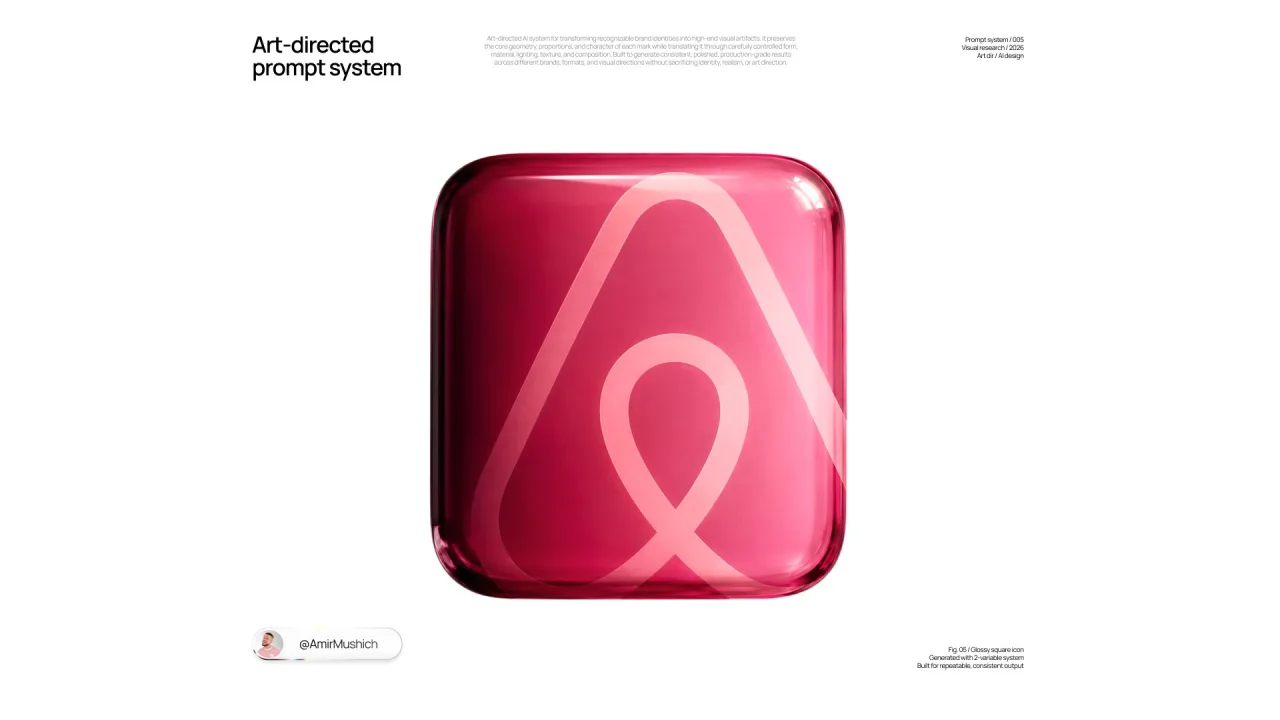
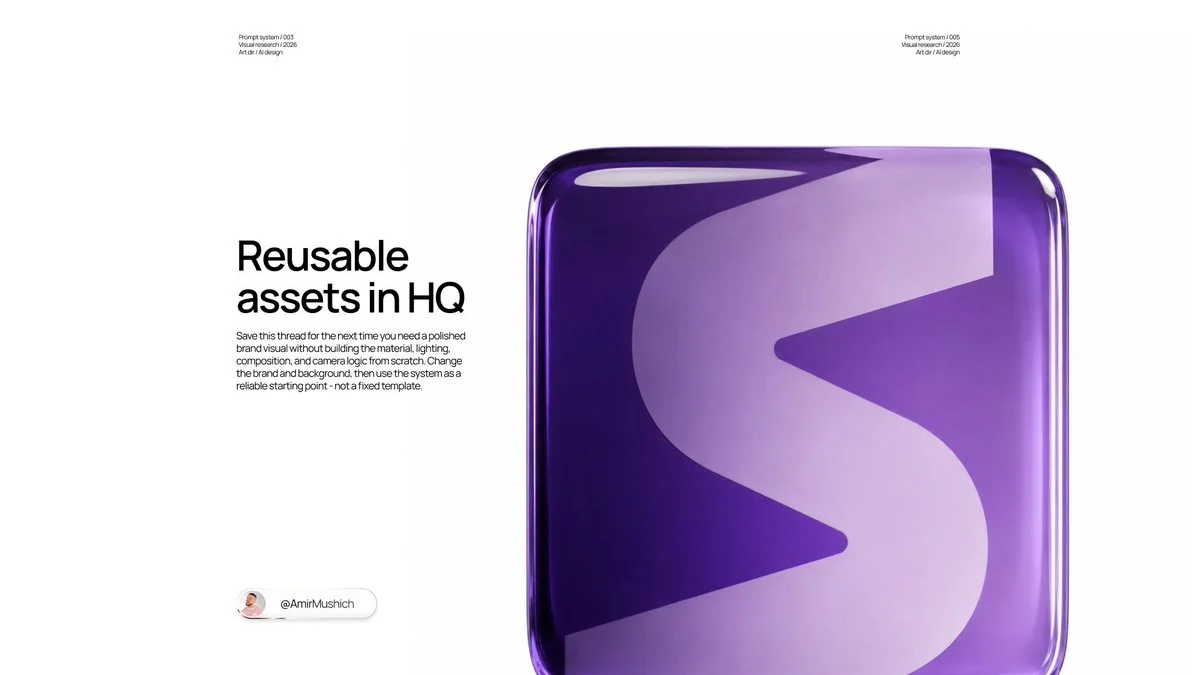
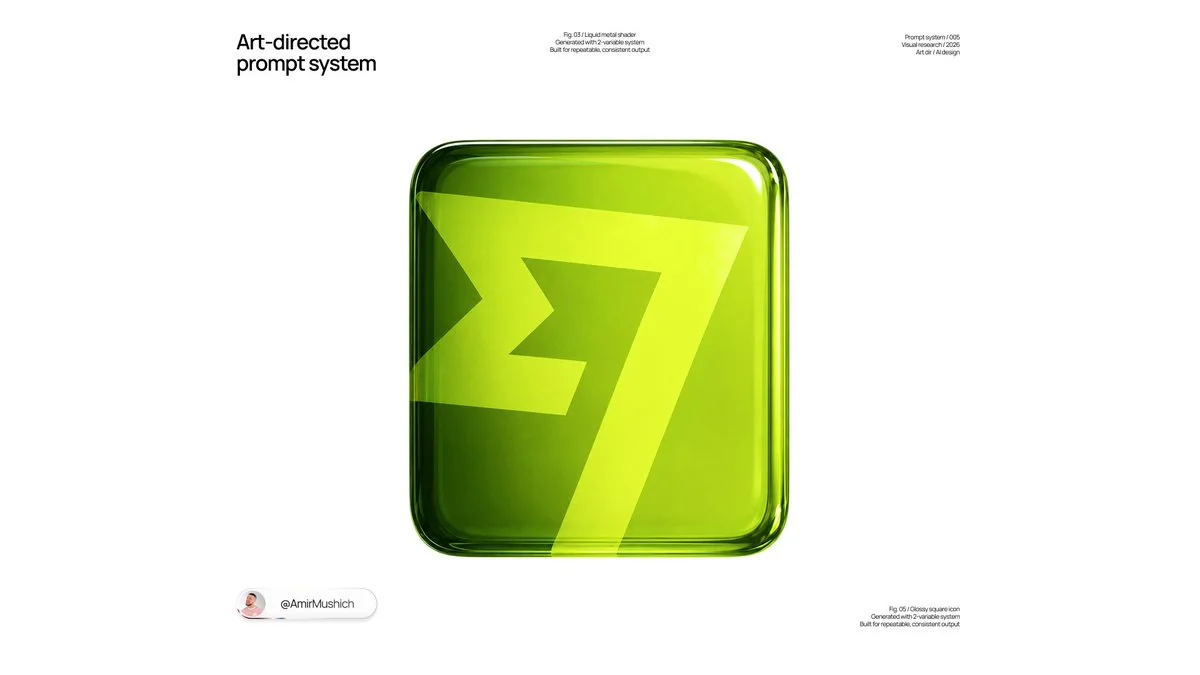
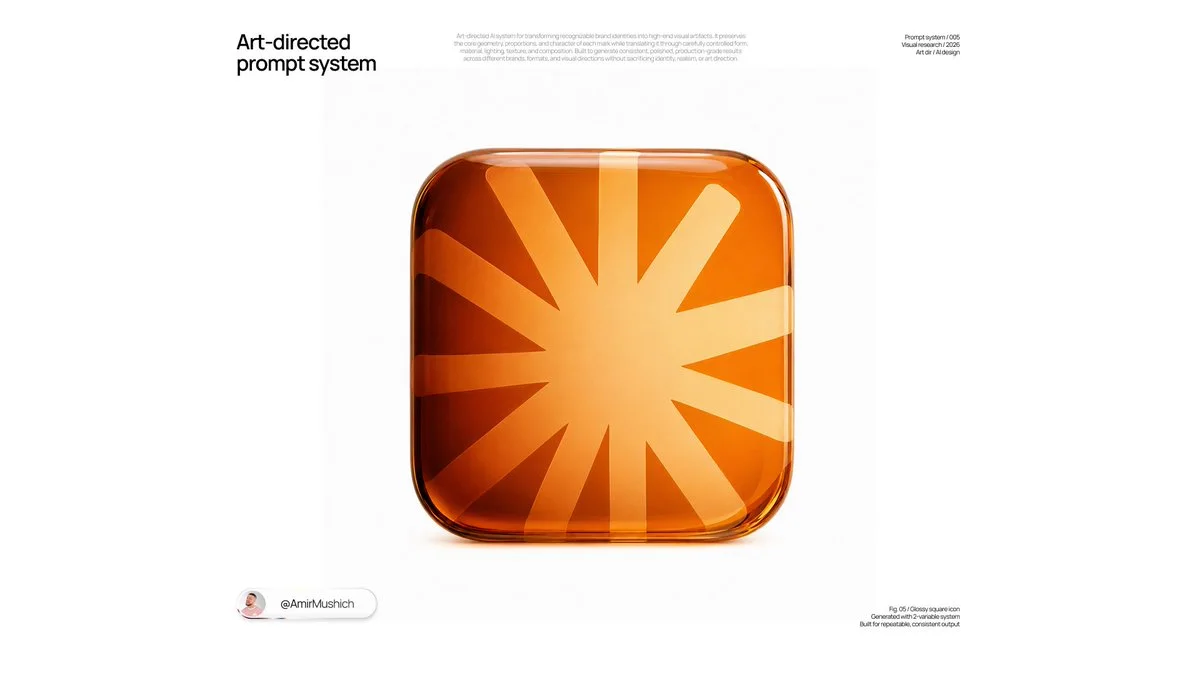
Ready to use
Prompt
[BRAND NAME = airbnb]
[BACKGROUND COLOR = pink]
[MODEL COLOR = pink]

Create a 16:9 path-traced studio CGI image of the authentic official standalone symbol of [BRAND NAME], transformed into a single-piece solid-glass icon.

CORE OBJECTIVE

Create one seamless rounded-square glass object containing an optically dense internal field controlled by [MODEL COLOR], one oversized brand symbol inside the glass volume, and one perfectly continuous polished outer surface. The result must feel like a photographed glass art object, not an app icon, UI asset, material test or conventional 3D logo mockup. Build the visual drama through light, color, transmission and optical density inside one homogeneous glass volume. Do not construct separate layers or components.

COLOR SYSTEM

Use [BACKGROUND COLOR] only for the external seamless studio background. Use [MODEL COLOR] as the dominant hue of the glass body, expressed through darker absorption zones, clearer transmitted midtones, brighter illuminated regions and deeper color accumulation near thick curved edges. Do not replace [MODEL COLOR] with a variation of [BACKGROUND COLOR].

Derive the internal logo color automatically as a pale, softly luminous companion tone that harmonizes with both variables. It must remain clearly lighter than [MODEL COLOR], share its hue family, remain compatible with [BACKGROUND COLOR] and feel like a lighter optical state of the same material. For neutral backgrounds, derive it mainly from a pale desaturated version of [MODEL COLOR]. For chromatic backgrounds, allow a restrained influence from [BACKGROUND COLOR]. Keep background, body and logo clearly separated in brightness and saturation.

BRAND ACCURACY

Use the most recognizable authentic official standalone symbol of [BRAND NAME]. Preserve its exact silhouette, canonical proportions, negative spaces, curves, terminals, intersections and spacing. Do not redesign, simplify, mirror, distort or replace the mark. Use the wordmark only when no official standalone symbol exists. Ignore native colors while preserving authentic geometry.

SINGLE-PIECE CONSTRUCTION

The object must read as one continuous mass of tinted glass: no outer frame, shell, front panel, insert, seam, border, bonded material or physical division between logo and body. The logo must exist only through internal color, translucency and optical-density variation inside the same glass volume. It must not affect the external surface height, curvature or roughness. Reflections must travel continuously across the body and logo without interruption, contour distortion or displacement.

CONTAINER GEOMETRY

Create a compact square glass tile with equal width and height, corner radius around 11–14% of its width, moderate thickness, restrained front convexity and continuous side walls. The front should be almost planar with only a subtle optical bulge. Keep the silhouette closer to a softened square than a pill-shaped app icon. Do not create an inflated, gel-like or heavily domed object; no raised perimeter, inner face, secondary rim, flange, double contour or separate bevel. The outer silhouette must be one continuous glass radius. From the near-frontal camera, reveal only minimal side thickness.

GLASS MATERIAL

Render physically thick, optically dense polished tinted glass: cool, hard, heavy, internally transparent, colored through absorption, perfectly smooth and free from plastic softness. Use clean refraction, controlled transmission, depth-dependent absorption, subtle internal reflection, mild edge darkening, restrained dispersion and optical compression near curved edges. The background must not remain clearly visible through the object. Avoid clear glass around an opaque core, resin, acrylic, lacquer, glossy plastic and clearcoat behavior.

MODEL COLOR FIELD

Fill most of the glass with [MODEL COLOR] as a true material hue, not a flat graphic fill. Create the darkest absorbed version toward the left and lower-left, denser accumulation near thick edges, clearer midtones through the center and slightly greater transmission near the upper-right. Keep gradients smooth and low-frequency. Preserve vivid hues while controlling saturation through thickness and absorption; preserve the temperature of neutral colors. Allow near-black zones only when compatible with [MODEL COLOR]. Do not illuminate the whole volume equally.

INTERNAL LOGO

Place the authentic symbol inside the glass as a pale, milky, softly translucent internal color field. It must be substantially lighter than the body yet affected by the absorption and transmission of [MODEL COLOR]. Keep it below pure white unless stronger contrast is necessary.

The logo must not appear printed, engraved, etched, carved, inset, embossed, raised, recessed, laminated, floating, bevelled, outlined or separated by a seam. Its perimeter must remain graphically precise, but the transition must occur only through internal hue, density and transmission. Do not add contour shadows, local ambient occlusion or surface deformation around it.

LOGO CROP

Uniformly enlarge the official symbol without changing its proportions. Do not present it fully visible with comfortable margins. Allow approximately 15–30% of the geometry to extend outside the visible internal field. Crop on multiple sides when appropriate; horizontally structured symbols should usually crop on both left and right, while vertical symbols may crop at top or bottom. Preserve the most recognizable geometry, create broad abstract light and dark regions, remove conventional safe-area spacing and distribute visual mass across the container. The crop must feel intentional, not accidental. Never convert the mark into an invented monogram.

INTERNAL LIGHT TRANSPORT

The logo must not have uniform brightness. On the left, reduce transmission, deepen the absorbed [MODEL COLOR], darken the pale logo and shift it toward a muted companion tone through gradual volumetric attenuation. Recover moderate luminosity toward the center. Toward the right and upper-right, allow slightly cleaner transmission and subtly brighter logo regions without turning them pure white. Shading must follow the complete glass volume, never the logo outline. The logo must not appear independently illuminated.

OPTICAL CLEANLINESS

The glass must be optically pure and internally homogeneous. Create depth only through smooth refraction, transmission and absorption gradients. No surface grain, rough micro-texture, orange peel, frost, speckling, procedural noise, bubbles, particles, haze, dust, cloudy density, mottling, dithering or denoising artifacts. Keep the surface perfectly polished and texture-free. The body and logo must contain clean, continuous, banding-free gradients. Any photographic grain may affect only the background and must never cross the glass, logo or reflections. Keep transmitted highlights below clipping.

LIGHTING

Use restrained asymmetrical photographic lighting that reveals selected parts of the object rather than evenly explaining it. Allow sections of the perimeter and interior to fall into deep optical shadow. Avoid balanced three-point lighting and full edge separation.

Use one distant elongated diffused reflection card above and slightly left of camera. It should create a restrained narrow upper reflection, subtle front-curvature information and gentle light penetration, without a broad white top bar or dominant illuminated cap. The reflection should vary in strength and may partially disappear.

Place one narrow vertical card to the right and slightly behind the object, creating only a short upper-right highlight, a partial right-edge reflection and slightly clearer transmission in that region. Do not illuminate the full edge or create a glowing perimeter.

Place a large black negative-fill card to the left, deepening the left edge and interior, darkening the logo there and increasing absorption. Keep the transition broad and gradual, never a hard stripe. Use minimal frontal fill at roughly 5–10% of the key intensity only to retain essential logo geometry. Do not use lower lighting; keep the bottom edge dark and quiet.

REFLECTION CONTROL

Use only one dim elongated upper reflection, one short upper-right reflection and a few extremely subtle internal transitions. No full rim light, repeated edge rings, nested reflective outlines, bright lower edge, dominant top band, multiple hotspots, windows, environment reflections, visible studio equipment, decorative caustics or strong bloom. Let some dark edges partially merge into the background.

TONAL STRUCTURE

Build the image from deep absorbed versions of [MODEL COLOR], richer midtones, pale internal logo regions, a few restrained bright reflections and large calm areas with minimal detail. Do not keep everything in a safe middle-value range. Preserve dense shadows without crushing them. Keep the logo below pure white and compress highlights softly so their shape remains visible.

BACKGROUND

Use [BACKGROUND COLOR] as a seamless matte studio field with a soft off-center illumination gradient, extremely subtle low-frequency tonal variation and no visible pixel-level grain. It must feel photographed rather than digitally generated. No centered radial halo, spotlight, bright aura, floor, horizon or wall transition. Keep the background visually distinct from [MODEL COLOR] while harmonizing with the logo.

CAMERA AND COMPOSITION

Use a centered near-frontal camera with 100–120 mm lens character, yaw and pitch around 0–2°, compressed perspective, minimal distortion and minimal visible side surfaces. Avoid wide-angle enlargement and dramatic three-quarter views. Keep the object effectively sharp at an f/8–f/11 equivalent, with only negligible softness at the most distant curved edge.

Compose in 16:9. Center the square glass object within broad negative space and let it occupy approximately 28–34% of the full frame width. The object must float in the air without touching or visually connecting to any surface. No floor, pedestal, contact point, cast shadow, drop shadow or bright halo. A nearly imperceptible broad tonal separation is acceptable only if it does not read as a shadow.

RENDER RESPONSE

Use high-sample physically based path tracing with accurate transmission, absorption, refraction, realistic thickness, controlled internal reflections, clean anti-aliased logo geometry and uninterrupted specular continuity. Use smooth 16-bit-like tonal transitions with no banding, render noise, path-tracing noise, denoising texture or dithering.

Apply restrained photographic finishing: filmic highlight roll-off, compressed reflections, deeper blacks, slightly muted highlight saturation, dense midtones, minimal highlight diffusion, no synthetic grain on the object, no obvious bloom, no artificial sharpening and no excessive microcontrast.

The final image should feel like a photographed glass art object whose body is controlled by [MODEL COLOR], placed against [BACKGROUND COLOR], with a pale internal logo harmonizing with both.

NEGATIVE CONSTRAINTS

No recessed, engraved, embossed, raised, inserted or separately illuminated logo; no bevelled logo edges, contour shadow, visible logo layer or decal; no outer frame, shell, inner panel, nested border, assembly seam, laminated construction, flange or double edge; no pill shape, inflated gel form or excessive front convexity; no plastic, acrylic, resin, clearcoat, chrome or metal; no surface grain, internal noise, haze, particles, speckling, mottling or denoising artifacts; no bright top stripe, continuous edge lighting, lower rim, glowing outline, neon, strong bloom or decorative caustics; no symmetrical lighting, complete logo with safe margins or one-sided crop; no radial background glow, floor, pedestal, horizon, cast shadow or drop shadow; no dramatic perspective, shallow DOF, external text, ignored [MODEL COLOR], clashing logo color or automatic replacement of [MODEL COLOR] with a variation of [BACKGROUND COLOR].
Continue browsing
Related prompts

Luxury glasshouse editorial portrait
Create a high-end photorealistic fashion editorial portrait of a woman inside a contemporary glasshouse botanical studio, wearing an ivory tailored suit beside a sculptural chair, surrounded by tropical leaves, glass panels, and dramatic sunlight.
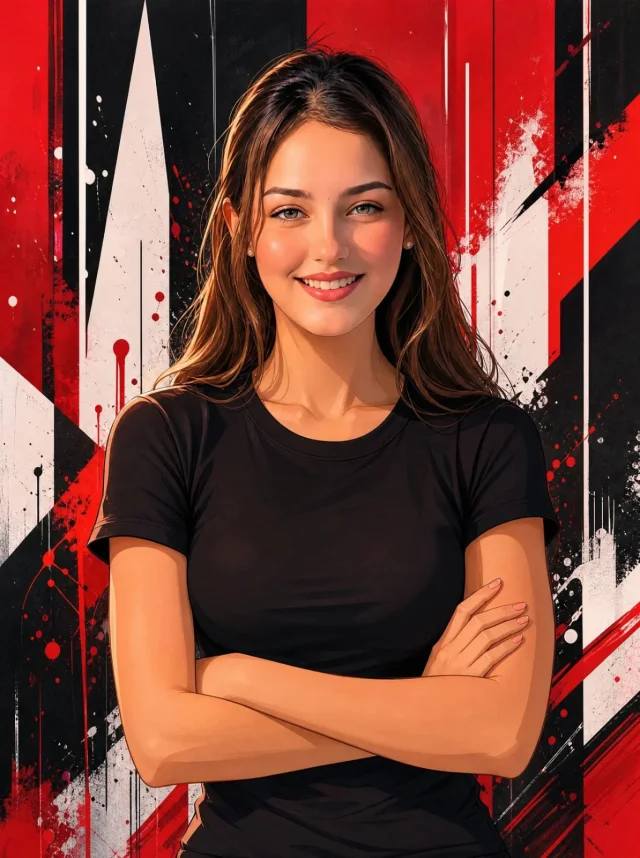
Anime graffiti face-reference portrait
Using a face reference, create a premium anime-style 9:16 portrait of a person in a fitted black t-shirt with crossed arms against a red, black, and white abstract graffiti background.
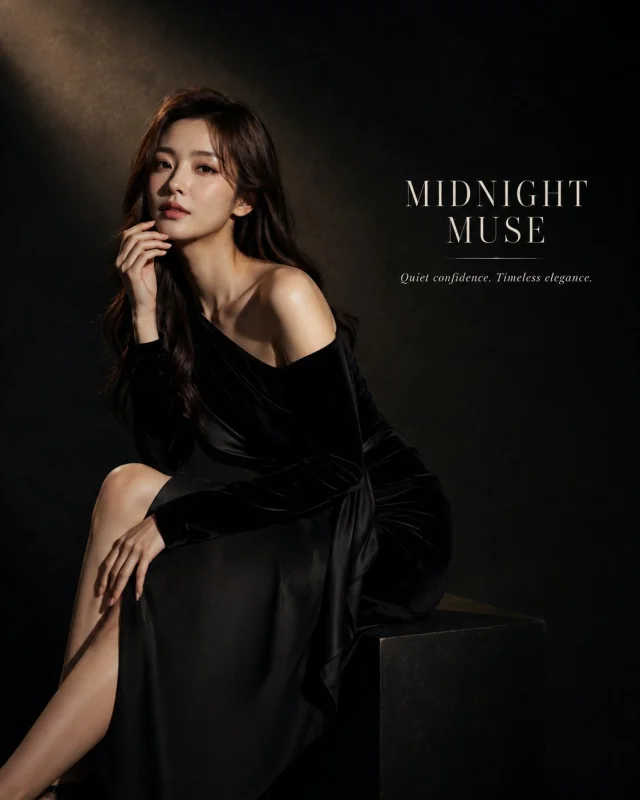
Korean editorial dark studio portrait
A master prompt for an ultra-realistic high-fashion editorial portrait of a Korean subject in a luxurious dark cinematic studio with dramatic lighting, minimal serif typography, and negative space.