
Viscous fiber-flow logo material
Transform a logo or attached image into a tactile macro 3D material field made from continuous viscous fiber-flow relief: dense elongated wet resin filaments, coherent vector currents, monochromatic pigment, anisotropic highlights, and a recognizable embedded logo or subject formed through changes in flow direction, density, and roughness.
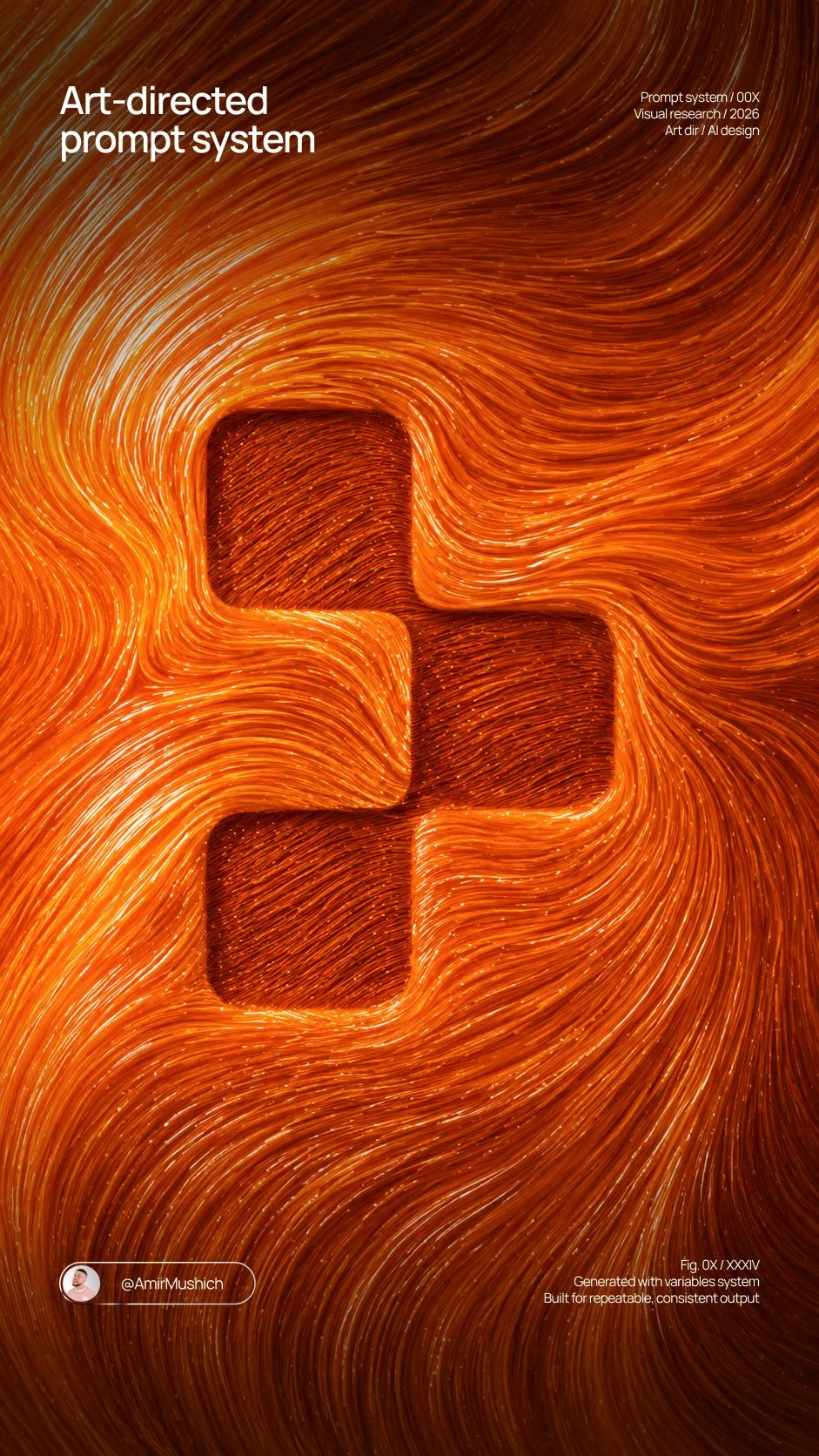
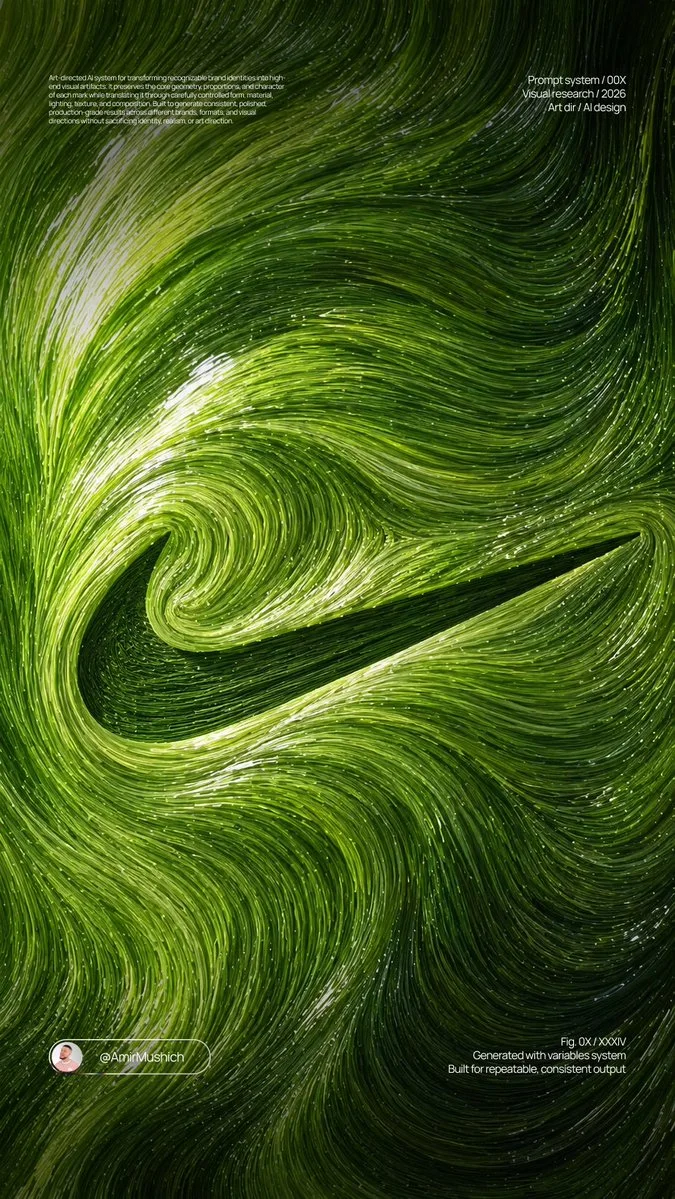
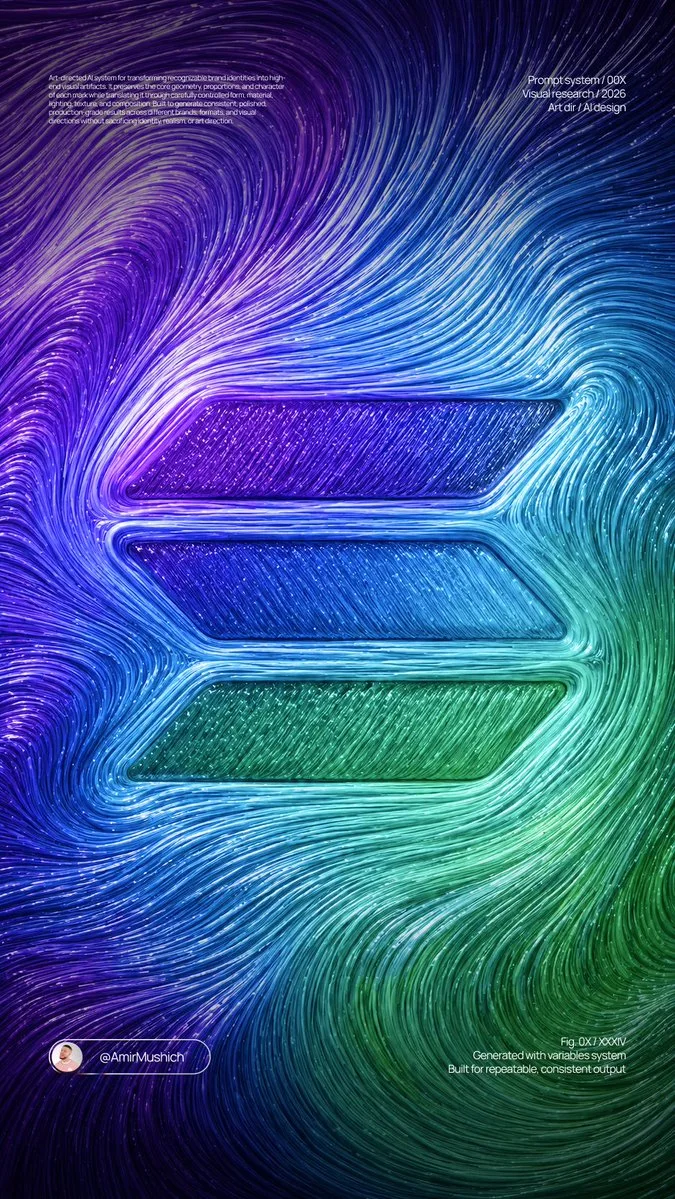

Ready to use
Prompt
[BRAND NAME = _________]
[MATERIAL COLOR = _____]
Create a highly tactile macro visualization using a continuous viscous fiber-flow relief system.
CORE VISUAL SYSTEM
Transform the entire image into one physically continuous field of thousands of densely packed elongated material filaments, resembling wet pigmented resin or thick lacquer that has been stretched into extremely fine flowing directional ridges.
The result must feel like a frozen viscous-fluid simulation viewed at macro scale.
Do not place a normal object or logo on top of a textured background.
The subject itself and its surrounding field must be constructed from the SAME flowing material system.
The defining visual language is:
— thousands of closely packed directional filaments;
— long smooth streamlines;
— broad swirling vector-flow structures;
— stretched S-curves and vortex-like circulation;
— localized compression and expansion of strands;
— microscopic height variation between ridges and valleys;
— elongated wet specular highlights following the exact direction of each filament;
— deep tonal valleys between brighter reflective strands.
The surface should feel fluid, brushed, viscous and physically tactile rather than hairy, furry or grassy.
SOURCE PRIORITY
If [SOURCE MODE = LOGO]:
Automatically identify the authentic official standalone symbol of [BRAND NAME].
Preserve its canonical silhouette, proportions, stroke relationships, curves, intersections, counterforms, internal negative spaces and component spacing.
Do not redesign, simplify or reinterpret the identity.
The authentic logo must remain immediately recognizable from normal viewing distance.
Do not create a conventional extruded, embossed, engraved or raised logo.
Instead, form the logo through a LOCAL CHANGE IN THE FLOW FIELD.
Inside the logo geometry, make the filaments slightly shorter, denser, darker and more tightly organized.
Around its outer and internal boundaries, smoothly bend and deflect the surrounding streamlines so the material appears to naturally flow around the authentic geometry of the symbol.
The boundary must remain precise enough to preserve brand recognition while still appearing integrated into one continuous material field.
If [SOURCE MODE = ATTACHED IMAGE]:
Use the attached image as the sole structural reference.
Preserve the original subject, silhouette, proportions, pose, orientation, major internal geometry, perspective and recognizable features.
Do not reconstruct the image as disconnected strands.
Translate its surfaces and surrounding areas into the same continuous viscous fiber-flow field while preserving immediate recognition of the original source.
Use changes in filament direction, density, brightness and roughness to describe the original forms.
FLOW ARCHITECTURE
Construct the filament pattern as a coherent large-scale vector field rather than random procedural noise.
Use a small number of broad directional currents and smooth vortex structures.
Filaments should travel in long continuous trajectories across the image.
Near important subject boundaries:
— gradually curve the streamlines;
— compress them slightly;
— increase directional coherence;
— create controlled local vortices where necessary;
— allow neighboring flows to separate and reconnect naturally.
The flow should feel dynamically stretched and internally pressurized.
Avoid chaotic turbulence.
Avoid short random strokes.
Avoid uniform parallel brushing.
Approximately 70–85% of visible filaments should belong to long coherent flow structures.
MATERIAL
Use a single monochromatic pigment family derived from [MATERIAL COLOR].
Create natural tonal variation entirely within that color family:
— almost-black shadowed pigment in deep valleys;
— saturated dark and mid-tone body color;
— brighter translucent-looking ridge edges;
— pale near-white reflections only where light directly catches the wet micro-relief.
Material character:
dense pigmented polymer resin,
viscous lacquer,
wet enamel-like surface,
continuous microscopic ridges,
subtle thickness variation,
slightly rounded filament profiles,
no dry fibers,
no fuzzy edges.
The material should appear recently flowed or brushed but completely frozen in place.
SHADING
Use strongly directional anisotropic shading.
Every filament must interact with light according to its orientation.
Create numerous narrow elongated specular reflections running along the strand directions.
Keep reflections physically connected to the microscopic ridge geometry rather than appearing as graphic white strokes.
Wet raised ridges:
roughness approximately 0.08–0.18,
tight elongated highlights,
strong but controlled reflectivity.
Deep valleys:
significantly darker,
reduced reflection,
restrained microscopic ambient occlusion.
Inside the primary logo or subject-defining regions:
slightly higher roughness,
fewer bright speculars,
greater pigment density,
deeper tonal value.
Maintain clear separation between highlight, body color and shadow while remaining within one material family.
LIGHTING
Use one large soft rectangular key light positioned above-front-left and slightly grazing across the surface.
The key light must skim across the microscopic relief rather than illuminating it flatly.
Its purpose is to generate long directional white and pale-[MATERIAL COLOR] reflections across raised filaments.
Add only a weak broad frontal fill to retain information inside darker valleys.
Use negative fill around the opposite side of the scene so some areas descend toward extremely deep versions of [MATERIAL COLOR].
No visible light sources.
No colored rim lights.
No neon glow.
No HDRI-style multicolored reflections.
The brightest zones should appear where the direction and curvature of the filament field align with the large soft light source.
REFLECTIONS
Treat reflections as part of the material geometry.
Reflections must:
— follow individual filament directions;
— stretch into thin continuous ribbons;
— vary naturally in length and width;
— break where the microscopic ridge curvature changes;
— cluster more densely in strongly illuminated flow zones;
— disappear gradually inside deep valleys.
Include occasional near-white high-energy glints but keep them sparse.
Never create a uniform glossy coating over the entire frame.
DEPTH AND RELIEF
Keep the overall construction shallow.
This is a micro-relief surface, not a landscape of large waves.
Large-scale depth changes should remain subtle while microscopic strand relief remains clearly visible.
The tactile impression should come primarily from dense ridges, self-shadowing, specular behavior and flow compression rather than large extrusion.
CAMERA
Macro studio camera positioned almost perfectly perpendicular to the material surface.
Use the visual compression of approximately a 90–120mm macro lens.
Minimal perspective distortion.
No wide-angle deformation.
No dramatic three-quarter camera angle.
The flowing surface fills the complete frame with no visible horizon or environment.
For LOGO mode, place the authentic symbol near the visual center and allow the surrounding flow to circulate naturally around it.
The logo should occupy approximately 30–45% of the image width rather than filling the frame.
For ATTACHED IMAGE mode, preserve the original composition and crop logic.
DEPTH OF FIELD
Keep almost the entire material plane sharply resolved.
Individual filament ridges and specular streaks must remain visible across most of the frame.
Only extremely subtle edge softness is allowed.
No obvious macro bokeh.
RENDER CHARACTER
Photorealistic path-traced macro material visualization with the tactile richness of an advanced Houdini procedural surface simulation rendered through physically based shading.
Extremely dense strand detail.
Natural microscopic variation.
Controlled anisotropic highlights.
Subtle self-shadowing.
Physically believable interaction between filament orientation and light.
The final image should initially read as a coherent flowing abstract material field, then reveal the authentic logo or source subject embedded inside that same physical flow.
NEGATIVE CONSTRAINTS
No conventional 3D extrusion.
No raised solid logo.
No bevelled emblem.
No separate logo object placed over a background.
No engraved logo.
No metallic chrome.
No glass.
No fabric.
No fur.
No hair.
No grass.
No feathers.
No wool.
No spaghetti-like tubes.
No isolated strings.
No random scribbles.
No short chaotic brush strokes.
No flat painted swirl texture.
No marble pattern.
No liquid splash.
No large ocean waves.
No heavy displacement.
No rainbow colors.
No neon.
No glow.
No artificial outlines around the logo.
No excessive depth of field.
No visible environment.
No decorative particles.
Continue browsing
Related prompts

Luxury glasshouse editorial portrait
Create a high-end photorealistic fashion editorial portrait of a woman inside a contemporary glasshouse botanical studio, wearing an ivory tailored suit beside a sculptural chair, surrounded by tropical leaves, glass panels, and dramatic sunlight.

Anime graffiti face-reference portrait
Using a face reference, create a premium anime-style 9:16 portrait of a person in a fitted black t-shirt with crossed arms against a red, black, and white abstract graffiti background.

Korean editorial dark studio portrait
A master prompt for an ultra-realistic high-fashion editorial portrait of a Korean subject in a luxurious dark cinematic studio with dramatic lighting, minimal serif typography, and negative space.